Tree Care Guides
Signs Your Tree Needs Professional Pruning
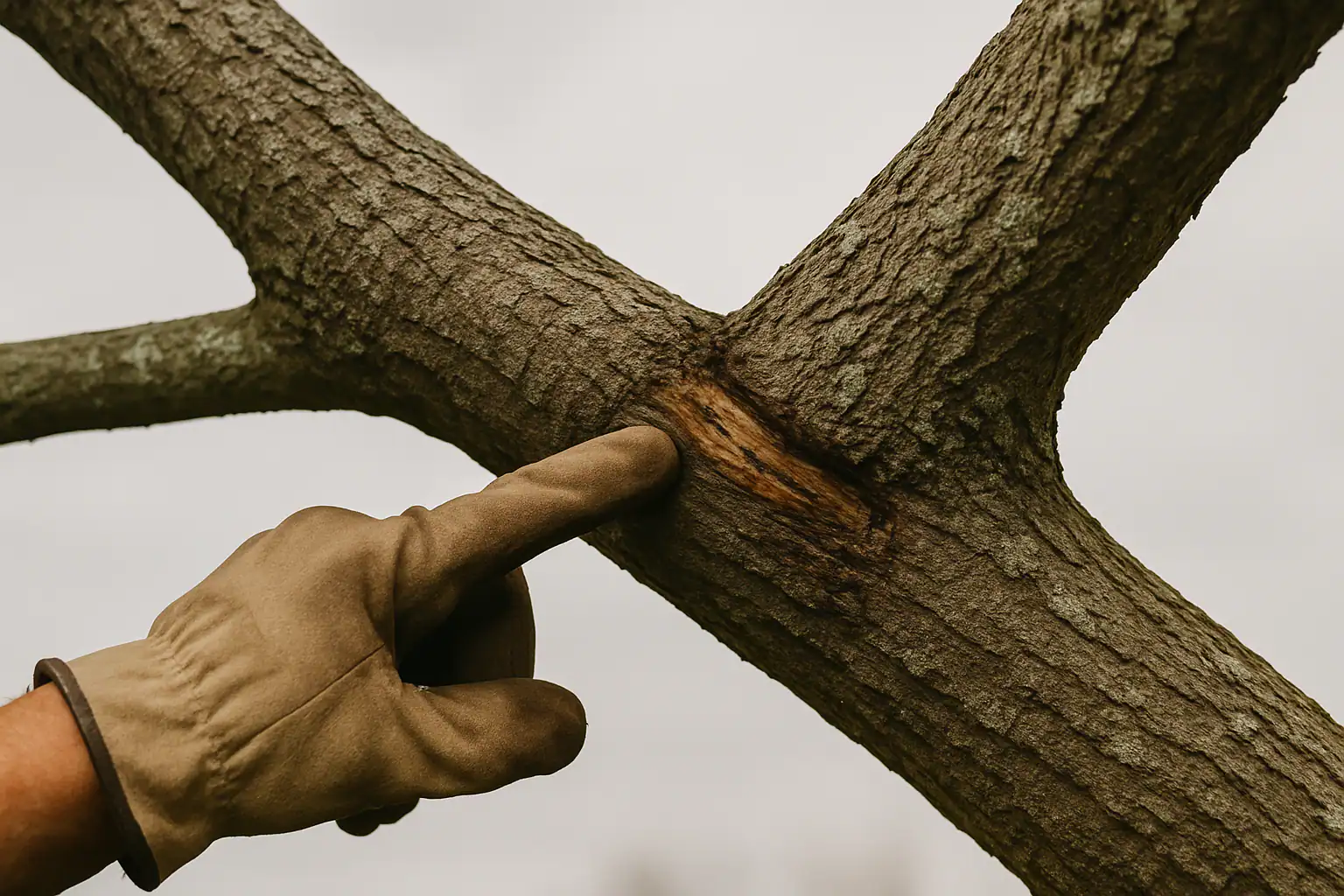
Crossing branches, accumulating deadwood, unusually dense canopies, weak branch junctions, storm-damaged stubs, unbalanced lean-growth, and declining fruit or flower production all signal professional pruning needs — each readable from ground level without climbing anything.
Sign One: Crossing and Rubbing Branches
Branches contacting each other wear bark wounds through wind motion — entry points for decay organisms precisely where moisture collects. One member of any crossing pair must eventually go; delaying chooses decay over decision.
Sign Two: Visible Deadwood Accumulation
Bare branches among living canopy aren't aesthetic issues — they're falling liabilities and decay highways. Small dead twigs scattered widely signal stress worth investigating; large dead limbs concentrated anywhere demand prompt removal regardless of other findings.
Sign Three: Canopy Density Blocking Its Own Light
Stand under and look up: if sky barely shows through, interior foliage is dying from shade starvation while outer growth sails wind loads disproportionately. Thinning restores internal vigor and reduces storm catch simultaneously — win-win rare enough to act on immediately.
Sign Four: Narrow or Included Crotches
- V-shaped trunk forks with bark pinched between stems — the classic split-in-ice architecture
- Limb attachments sharper than roughly 45 degrees carrying meaningful weight
- Multiple stems racing upward from single points competing for dominance
These geometries fail predictably under load. Early structural pruning redirects growth toward sound attachments while trees remain young enough to redirect cheaply.
Sign Five: Old Storm Stubs and Torn Limbs
Improper healing from past damage — jagged stubs, torn bark flaps, flush-cut scars cracking outward — indicates wounds needing corrective attention before rot advances inward. Trees seal wounds only through collar growth; badly placed cuts never close properly.
Sign Six: Lopsided Growth After Crowding Events
Trees leaning toward yard openings after neighbor-tree removals, construction clearing or field-edge exposure develop sail-heavy sides. Rebalancing reduction on the heavy side prevents the lean-compensation cycle ending in root failure during saturation events.
Sign Seven: Production Decline on Fruit and Ornamentals
Flowering and fruiting track light penetration directly. Dense old canopies produce increasingly marginal crops despite adequate water and nutrition — restoration pruning over two-three seasons reverses trajectories dramatically on most species.
Recognizing several signs simultaneously strengthens urgency — combinations compound. Around Concordia and greater Lafayette County, assessments translating signs into scopes start at (855) 714-0391. Extend your vocabulary with dead-branch identification and unsafe-tree warning signs.