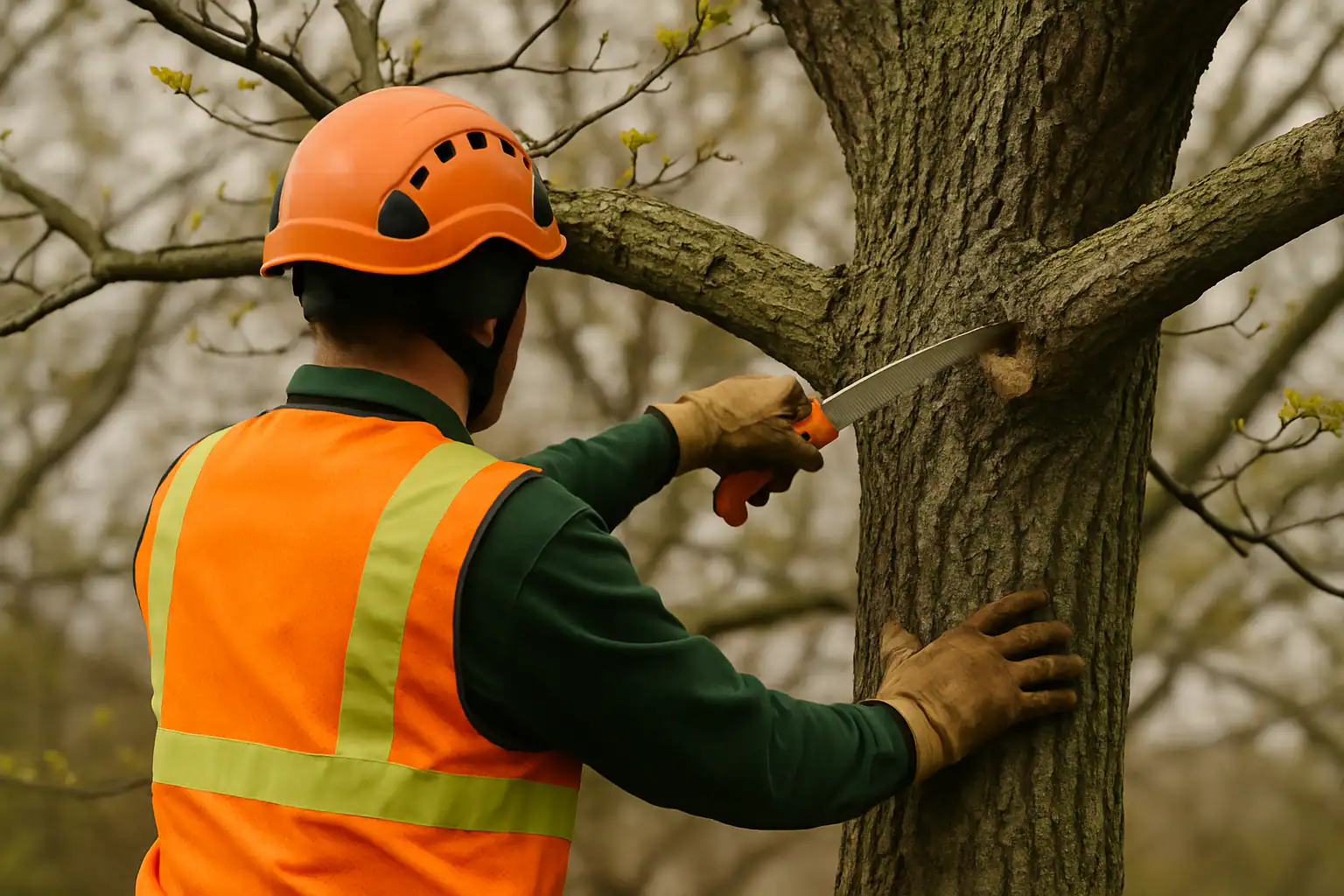
If you have a young tree heading toward a fork-in-the-trunk future, fruit trees that stopped producing well, or a mature oak with suspicious cracks at its crotch, call (855) 714-0391 for an honest assessment.
Trimming vs. Pruning — Same Visit, Different Goal
People use the words interchangeably, and that's fine, but the intent differs: trimming manages size and clearance; pruning manages health and structure. In practice one visit often does both. If you want the full comparison, we wrote a plain-English guide to trimming vs pruning — the short version is that pruning decisions require looking at branch collars, angles and load paths, not just what's poking the gutter.
What Structural Pruning Fixes
- Co-dominant stems — two trunks racing upward with bark squeezed between them; the classic split-in-a-storm failure
- Included bark crotches where limbs attach at sharp angles and push against each other
- Crossing and rubbing branches that wound each other annually
- Limb-heavy ends that catch wind and ice disproportionately
- Suckers and watersprouts stealing energy from real canopy
- Early training cuts on young trees — cheap now, priceless in twenty years
Timing Windows That Actually Matter in Missouri
Oaks: never prune April through July. Fresh oak wounds in that window attract the sap-feeding insects that carry oak wilt, which is fatal and present in Missouri. Prune oaks in late fall or winter. Elms follow similar logic for Dutch elm disease — dormant-season pruning preferred. Fruit trees produce best with late-winter pruning while dormant. Maples and birches bleed sap if cut in late winter; it looks alarming and is harmless, but if it bothers you prune them in early summer instead. Deadwood and hazard limbs: any time safety requires.
Ash Trees: Check Before You Spend on Pruning
Emerald ash borer has been detected in Lafayette County, and pruning money spent on a declining ash can be wasted if the tree is already infested. Signs include crown thinning from the top, D-shaped exit holes in bark and increased woodpecker activity. We'll tell you straight whether your ash is worth investing in or belongs on a removal timeline instead.
How Pruned Trees Should Look When We Leave
No stubs, no flush cuts, no paint globs. Every cut goes just outside the branch collar so the tree seals it naturally. The canopy should look like itself — thinner where it needed thinning, balanced against prevailing winds, and clear of structures — not sheared into a ball. If you've ever seen a 'pruned' tree that looks like a broccoli crown, that wasn't pruning; that was someone billing by the hour with a saw.
Tree Service in Nearby Communities
- Tree Pruning in Corder, MO
- Tree Pruning in Lexington, MO
- Tree Pruning in Higginsville, MO
- Tree Pruning in Lafayette County, MO